 Landscape Photography
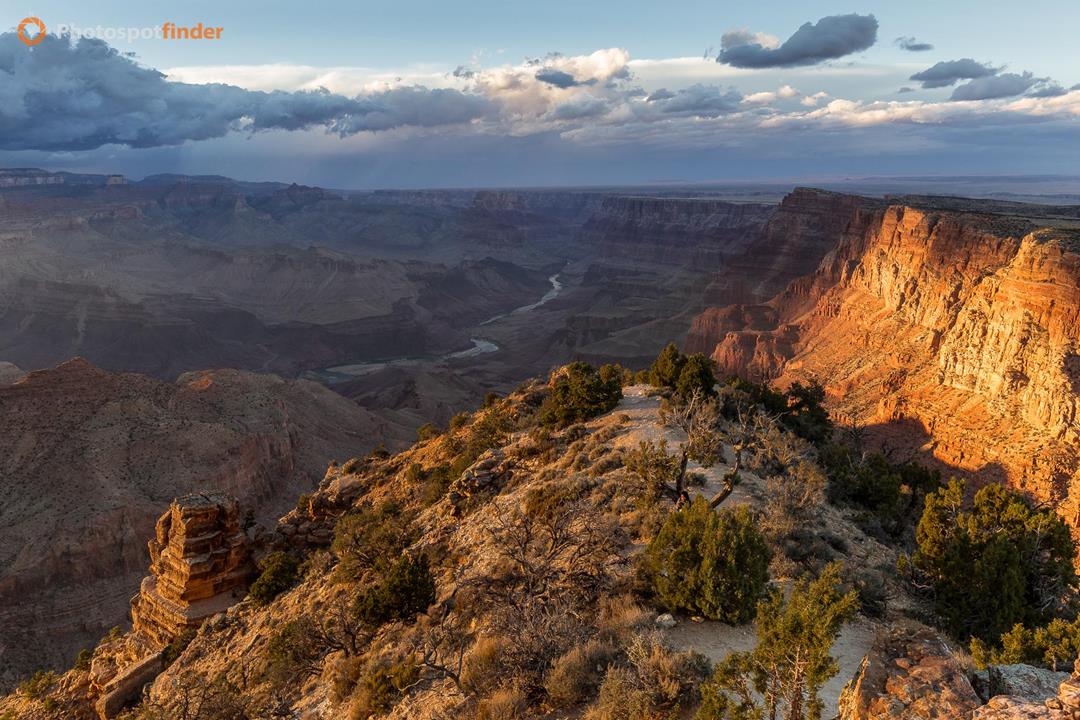
Last Light at Desert View, Grand Canyon National Park
Sunset at Desert View brings warm, angled light across the eastern Grand Canyon, revealing strong color separation in the cliffs and deep canyons below. From this high overlook, the terrain opens into a wide network of ridges, terraces, and vertical walls shaped by erosion along the Colorado River corridor. The upper layers take on saturated reds and oranges as the sun lowers, while the inner gorge shifts toward cooler tones, creating a clear gradient that emphasizes depth and scale. Desert View sits near the park’s eastern boundary, where the canyon broadens, and long sightlines extend toward distant mesas and plateaus. The high desert environment supports sparse vegetation, leaving most of the scene defined by exposed rock, sedimentary layering, and sharp relief shaped by millions of years of uplift and incision. Evening conditions often produce stable visibility, allowing the canyon’s stratified structure to appear crisp even as shadows lengthen. As the sun approaches the horizon, contrast increases rapidly, and the canyon shifts from warm illumination to deep shadow in a matter of moments. The elevated position and unobstructed view make Desert View a strong location for observing how low-angle light interacts with the canyon’s complex topography at the end of the day.

|
Canon EOS 6D EF16-35mm f/4L IS USM |
||

|
f/11.0 |

|
1/80 sec |

|
400 |

|
24 mm |